
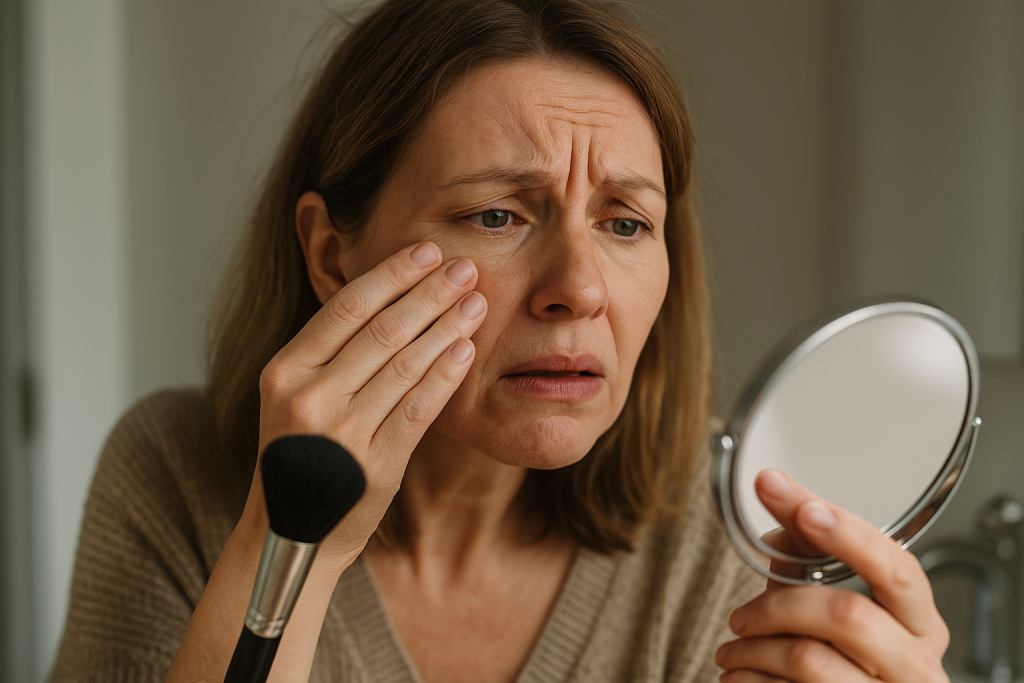
I used to believe makeup was a form of armor—the more I applied, the more protected I felt from the world’s scrutiny. Standing before my vanity mirror at forty-five, armed with every anti-aging product the beauty industry had convinced me I needed, I was unknowingly painting myself into a corner of premature aging.
The irony struck me during a chance encounter with my college roommate at our twenty-fifth reunion. “You haven’t aged a day,” she remarked, and when I laughed about my elaborate makeup routine, she gently suggested I might be trying too hard. That night, studying photos from the event, I saw what she meant—my face looked stiff, mask-like, older somehow than my bare-faced peers.
This revelation launched me on a journey through the beauty industry’s most pervasive myths, consulting with makeup artists, dermatologists, and women who’d learned these lessons the hard way. What I discovered challenged everything I thought I knew about “age-appropriate” makeup.
1. The Foundation Fortress: When Coverage Becomes a Cage
For years, I believed that flawless skin meant invisible pores and a perfectly matte finish. I layered foundation like spackle, convinced that more coverage meant more youth.
Dr. Sarah Chen, a dermatologist in Manhattan, shattered this illusion during our consultation. “Heavy foundation settles into fine lines within hours,” she explained, demonstrating on half my face. The difference was shocking—the heavily made-up side looked ten years older by noon.
The real secret, I learned, lies in skin preparation and strategic application. Now I mix my foundation with a hydrating serum and apply it only where needed, letting my skin’s natural texture show through. The result is more youthful than any full coverage could achieve.
2. The Powder Paradox: Setting Yourself Up for Failure
My grandmother’s compact powder was a constant companion, and I inherited both the compact and the habit. Setting my makeup with generous dustings of powder felt like preserving my morning efforts.
Celebrity makeup artist Marcus Williams opened my eyes during a workshop in Los Angeles. “Powder is aging’s best friend,” he said, showing how it accentuates every line and creates a flat, lifeless finish. He demonstrated the difference between a powdered face and one finished with setting spray—the transformation was remarkable.
I’ve since discovered that targeted powder application—only on the T-zone and areas prone to shine—maintains longevity without the aging effect. The rest of my face remains luminous and alive, reflecting light rather than absorbing it.
3. The Concealer Conspiracy: Brightening That Backfires
Fashion magazines taught me to apply concealer in triangles beneath my eyes, promising to erase decades of fatigue. I followed this advice religiously, using shades lighter than my skin tone for maximum “brightening.”
It wasn’t until a professional headshot session that photographer Elena Rodriguez pointed out the problem. Under her studio lights, my under-eye area looked gray and unnatural, creating the very shadows I was trying to hide. She called in her makeup artist, who showed me how concealer should enhance, not mask.
The correct approach uses a concealer that matches your skin tone exactly, applied sparingly only to areas of darkness. The goal isn’t to create artificial brightness but to neutralize shadows while maintaining the natural contours of your face.
4. The Matte Mistake: Chasing Youth in All the Wrong Places
Oily skin in my twenties led to a lifelong pursuit of matte perfection. Every product in my arsenal promised to eliminate shine, and I equated dewiness with greasiness.
Meeting French makeup artist Celeste Dubois changed my perspective entirely. “Matte skin is dead skin,” she declared in her Parisian studio, showing me photos of models in their fifties who looked decades younger thanks to strategic luminosity. She taught me that youthful skin reflects light—it’s alive, dimensional, and never completely flat.
Now I embrace cream products and illuminating formulas, understanding that a subtle glow reads as health and vitality. The fear of shine has given way to an appreciation for skin that looks like skin.
5. The Eyebrow Betrayal: When Definition Becomes Harsh
The bold brow trend seemed like salvation for those of us with sparse eyebrows. I invested in pomades, pencils, and stencils, creating Instagram-worthy arches that could cut glass.
My wake-up call came from an unexpected source—my teenage daughter. “Mom, your eyebrows look angry,” she said one morning. Looking closely, I realized my quest for definition had created harsh, unnatural lines that hardened my entire face.
Working with brow specialist Keiko Tanaka taught me that softer, feathered strokes and a slightly lighter shade create a more youthful frame for the face. The goal is enhancement, not transformation, allowing the natural flow of your features to shine through.
6. The Lip Line Lie: Overlining Your Way to Aging
Social media convinced me that overlining my lips would restore the fullness of youth. Armed with lip liner darker than my chosen lipstick, I drew beyond my natural borders, believing the illusion was seamless.
The truth revealed itself in daylight during a lunch with clients. Catching my reflection in a window, I saw what everyone else did—obvious lines that screamed artificiality. My attempt at youth had achieved the opposite effect.
Professional makeup artist Diana Chen taught me that true lip enhancement comes from proper hydration, subtle liner that matches the lipstick, and strategic highlighting on the cupid’s bow. The effect is naturally fuller lips without the telltale signs of trying too hard.
7. The Shimmer Trap: When Sparkle Turns to Spotlight
Highlighter promised to be the fountain of youth in a compact. I applied it liberally—cheekbones, nose, forehead, chin—chasing the “glow from within” that influencers made look effortless.
A harsh reality check came during a video conference call. The ring light revealed every particle of shimmer, creating a disco ball effect that emphasized texture and pores. My colleague’s gentle suggestion to “adjust the lighting” was code for “tone down the highlighter.”
I’ve learned that strategic highlighting means choosing cream formulas over powder, applying with a light hand, and focusing on one or two areas maximum. The goal is to mimic how light naturally hits a youthful face, not to create an artificial light show.
8. The Bronzer Blunder: Contouring Away Your Youth
Contouring videos made it look so simple—shadows here, highlights there, and suddenly you have supermodel cheekbones. I became obsessed with creating definition, using bronzer to carve out features I wished I had.
The problem became apparent in photographs from a beach wedding. While I thought I looked sculpted, the camera revealed muddy stripes and an unnaturally gaunt appearance. The very technique meant to enhance had aged me dramatically.
Makeup artist Roberto Silva taught me that subtle warmth, not dramatic shadows, creates a youthful appearance. A light dusting of bronzer where the sun naturally hits—forehead, nose, chin—brings life to the face without the harsh aging effects of heavy contouring.
9. The Mascara Mayhem: When More Becomes Less
My mascara collection rivaled a beauty store’s inventory. Lengthening, volumizing, curling—I layered them all, believing that dramatic lashes equaled youthful eyes.
The turning point came during an allergy season when my eyes watered constantly. The mascara migration throughout the day created dark circles and emphasized every fine line. My dramatic lashes had become aging raccoon eyes.
I discovered that one coat of a quality mascara, focused on the roots for definition rather than the tips for drama, opens the eyes without weighing them down. Sometimes less truly is more, especially when it comes to preserving a youthful appearance.
10. The Blush Blunt: Misplaced Color That Ages
Following my mother’s advice from the 1980s, I smiled and applied blush to the apples of my cheeks. On a youthful face, that pop lands high and buoyant; on a mature face, “the apples” sit lower, so color placed there drags everything south. The result is a heavy, ruddy patch that visually pulls the mid-face downward—exactly the opposite of what we want.
The modern fix is lift, not flush. Place cream or gel blush slightly above where you think—on the upper outer cheek, then blend upward toward the temples in a soft C-shape. Choose luminous, not glittery, textures and tones that mimic a natural flush (peachy rose, warm pink). If in doubt, tap the excess across the bridge of the nose for cohesion. Instantly, the face looks fresher and more lifted.
11. The Undertone Error: Base That Doesn’t Match Your Neck
A too-pale, too-yellow, or too-pink base announces itself like a mask—and nothing ages faster than a visible line of demarcation. As skin tone and undertone shift with time (thanks, hormones and sun), the foundation shade that worked five years ago can now turn sallow or ashy, exaggerating sallowness or redness and flattening the face.
Always shade-match in daylight to your jaw/neck/chest zone, not just the face. If your face is redder than your chest, correct with a sheer green or peach corrector only where needed, then use a neutral-leaning foundation that blends seamlessly into the neck. Keep undertone adjuster drops (olive, golden, or blue) to nudge a favorite formula back in harmony, and run a touch of remaining base over ears and hairline to erase telltale edges.
12. The Prep Skip: Makeup on Dehydrated, Unprepped Skin
No formula can fake healthy skin. Applying makeup to dry, flaky, or tight skin guarantees settling, pilling, and exaggerated lines. Primer can’t rescue a parched canvas; it just smooths over the problem for an hour before everything cracks and collects.
Think skincare-first: mist or press in a humectant (hyaluronic, glycerin), seal with a light emollient, and spot-occlude only where you’re driest. Let skincare set, then use a thin, smoothing primer only on texture-prone areas (sides of nose, inner cheeks). Clean tools matter too—dirty brushes deposit excess product and micro-clump on fine lines. With a hydrated canvas and fresh tools, even minimal makeup reads youthful, not effortful.
What’s Your Plant-Powered Archetype?
Ever wonder what your everyday habits say about your deeper purpose—and how they ripple out to impact the planet?
This 90-second quiz reveals the plant-powered role you’re here to play, and the tiny shift that makes it even more powerful.
12 fun questions. Instant results. Surprisingly accurate.
link