
New York Fashion Week has long carried a reputation as the most commercial of the global circuits—less high-fashion chic than Paris, less theatrical than Milan. In recent years, the event seemed to fade into irrelevance, a calendar fixture more than a cultural force of Tommy Hilfiger realness.
But NYFW has been enlivened with a new guard of independent brands and forward-thinking designers, and a newly established hub at the WSA Building (South Street Seaport fashion adjacency is still surreal but seems here to stay). The WSA tower, with shows staged across multiple floors, has quietly replaced the long-lost tents and Milk Studios as a central venue. Outer-borough outings, once unthinkable, are now the norm, and despite cost-cutting measures across industries, art collaborations are spicing things up. The runway shows have wrapped, and there were many standout art and fashion crossover moments to note, from runway collaborations, to capsule collection, and exhibitions.
An Art World Debut


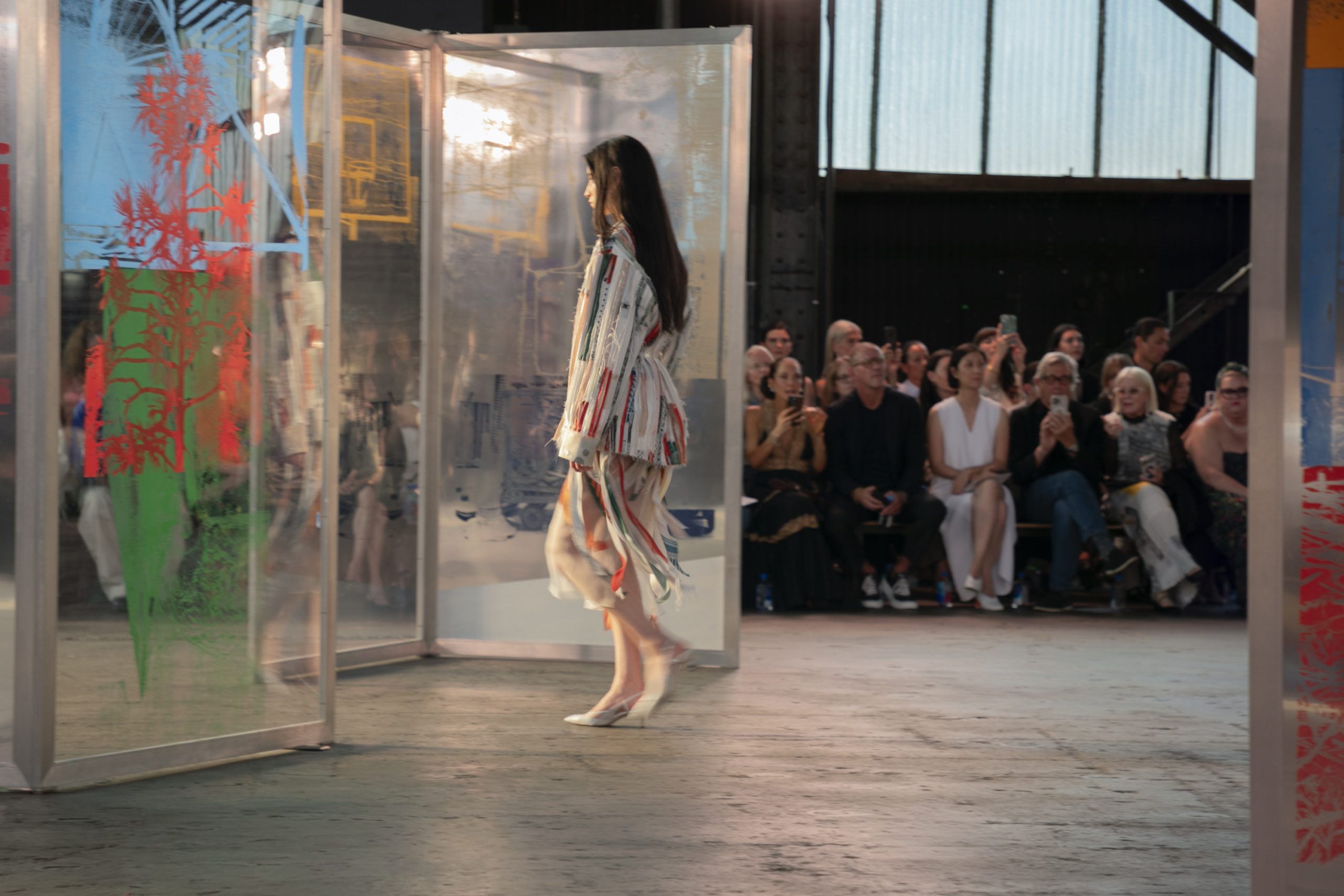
A model walks the runway during the Proenza Schouler Ready to Wear Spring/Summer 2026 fashion show as part of the New York Fashion Week on September 10, 2025 in New York. (Photo by Victor VIRGILE/Gamma-Rapho via Getty Images)
Gallery and museum spaces are always a go-to venue choice to really send the message that a brand is art world-connected. There may not have been a special Azzedine Alaïa show at the Guggenheim Museum like there was last spring season, but Proenza Schouler did lean into the city’s cultural infrastructure, showing its Spring/Summer 2026 collection at Kasmin Gallery in Chelsea. The collection was designed by Rachel Scott in her first outing as creative director after the departure of founders Jack McCollough and Lazaro Hernandez.
This was Scott’s careful prelude to what will be her official full-scale debut in February 2026. Scott’s “soft opening” vision surfaced in laser-cut coated cotton, frayed jacquards, and deconstructed tailoring with exposed shoulder pads. Tropical accents and raffia details nodded to her Jamaican heritage, while the overall effect stayed true to Proenza’s reputation as a gallery-goers’ uniform. Meanwhile, McCollough and Hernandez are preparing their first Loewe collection, set to debut in October at Paris Fashion Week.
Art History on the Runway


Jason Wu Spring/Summer 2026 runway show scenography. Photo: Andres Altamirano, courtesy of Jason Wu.
This year marks the centennial of Robert Rauschenberg’s birth, with exhibitions planned around the world. Jason Wu’s runway show could have served as one of them, his Brooklyn Navy Yard stage transformed into a veritable Rauschenberg showcase. Partnering with the Robert Rauschenberg Foundation, Wu staged his “Collage” collection inside A Quake in Paradise (Labyrinth) (1994), a monumental installation loaned by the Foundation. Transparent, opaque, and reflective panels layered with Rauschenberg’s own photographs refracted the models into living collages.

A look from Jason Wu Spring/ Summer 2026. Photo: Dan Lecca. Courtesy of Jason Wu.
The clothes themselves carried this spirit of recomposition. Granted rare access to the Foundation’s holdings, Wu concentrated on Rauschenberg’s “Hoarfrosts” (1974–76) and Airport Suite (1974), series that marked a decisive turn in the artist’s engagement with textiles during the 1970s. The Hoarfrosts are unstretched panels of silk, muslin, and cheesecloth imprinted with solvent-transferred images from magazines and newspapers—works that hang freely and shift with the air, their ghostly impressions recalling Rauschenberg’s longstanding interest in the instability of the image. Created in the same period, Airport Suite extended these transfer processes into layered fabric prints that combined newsprint fragments, photographic transfers, and collage.


Robert Rauschenberg, Cat Paws (Airport Suite) (1974). From an edition of 20 Arabic and 20 Roman numerals, published by Graphicstudio, USF, Tampa, Florida. Photo: James Nelson
Wu not only drew on these sources but incorporated actual imagery from Rauschenberg’s work, translating the artist’s sensibility into silhouettes that could be as architectonic and structurally assertive as his “Combines,” yet also delicate in their juxtaposition of pattern with transparency, solidity with tatters. Together these references underscore how Rauschenberg was collapsing distinctions between printmaking, textile, and installation in the 1970s—an experimental energy that Wu adapted into a contemporary fashion language.

A look from Jason Wu Spring/ Summer 2026. Photo: Dan Lecca. Courtesy of Jason Wu.
“It has been a dream come true working with the Rauschenberg Foundation and having access to his incredible body of work,” Wu said. “This collection, themed ‘Collage,’ is my tribute to Mr. Rauschenberg’s work and my personal journey as an immigrant who collects what seem disparate references into my creations.”
Outfitting Frankenthaler

A runway look inspired by Helen Frankenthaler. Courtesy of Ulla Johnson.
Ulla Johnson staged her Spring/Summer 2026 show at the Cooper Hewitt Design Museum, Andrew Carnegie’s former Beaux-Arts mansion—the perfect setting for a luxury brand deeply attuned to art and design. Collaborating with the Helen Frankenthaler Foundation, Johnson filled her well-honed silhouettes with cascades of Abstract Expressionist color. The soundtrack merged music with snippets of Frankenthaler speaking in a 1993 interview. “‘Beautiful’, which is always a tricky word, but now it’s become an incendiary word, because in many ways today beauty is obsolete and not the main concern of art. And you can’t prove beauty; it’s there as a fact,” echoed Frankenthaler’s voice as models emerged onto the carpeted catwalk.


Helen Frankenthaler, Moontide (1968).
Helen Frankenthaler Foundation, New York
© 2025 Helen Frankenthaler Foundation, Inc. / Artists Rights Society (ARS), New York. Courtesy of the Helen Frankenthaler Foundation
Far from treating the clothes as blank canvases, there was a lot of design going on: roomy pant suits with pleated puff sleeves, oversized flowing gowns, and ruched dresses with pilgrim collars. And yes, this collection hits at a perfect moment, as a prelude to the upcoming “Helen Frankenthaler: A Grand Sweep” at MoMa in October. Synergy!


Backstage at the Helen Frankenthaler-inflected Spring 2026 show. Courtesy of Ulla Johnson.
For Johnson, this Frankenthaler-inspired collection continues a long-running dialogue with art. Last year, she collaborated with Kasmin Gallery and Julie Hamisky, granddaughter of Les Lalanne, who contributed a giant electroplated poppy sculpture to her runway and created gilded floral jewelry for the collection. Before that, Johnson incorporated Lee Krasner prints into her ready-to-wear. Raised in New York and steeped in its art scene, Johnson treats art less as an occasional inspiration than as a language embedded in her design DNA.


A model wears a Heaven by Marc Jacobs x David Rappeneau sweater. Courtesy of Heaven by Marc Jacobs.
Heavenly Team-up
Heaven by Marc Jacobs introduced a capsule featuring prints by the elusive French artist David Rappeneau, whose moody, hyper-figurative drawings of melancholic youth have fueled his cult following. As Kate Brown noted in Artnet, his characters are “caught between melancholy and rapture.” The collaboration makes his imagery, usually glimpsed in gallery shows at Gladstone, available on a zip-up hoodie, a mesh long-sleeve, a sweater, and a shoulder bag.
Cultural Crossovers Continue


Paolo Roversi, Sihana, Paris, 2023. Courtesy of Pace.
One of the week’s standout cultural crossovers came from Paolo Roversi, the legendary Italian fashion photographer whose elegiac style has defined decades of fashion imagery. Pace Gallery opened his exhibition “Along the Way” in Chelsea coinciding directly with Fashion Week (it runs through October 25). The show spans 25 years of Roversi’s large-format Polaroids and dreamlike portraits, inspired by the likes of August Sander, Robert Frank, and Diane Arbus. It situates Roversi firmly within the canon of both art photography and fashion, underscoring why he remains such a lodestar for designers and image-makers.
Often seen in the fashion world as much as an art photographer, Roversi is known for his soft, painterly aesthetic: washed-out tones, muted color palettes, gentle diffusion of light, intimate yet somewhat ethereal portraits.


Paolo Roversi, Hawk, Paris, (2020) Courtesy of Pace
Alongside Roversi, another moment blurred the lines between fashion and art on institutional ground. The Museum at FIT opened “Dress, Dreams, and Desire: Fashion and Psychoanalysis” during the week, curated by Valerie Steele, the museum’s director who is often dubbed “the Freud of Fashion.” The exhibition is the first to trace the cultural history of dress through psychoanalysis, drawing on five years of research and nearly 100 works by designers including Alaïa, Chanel, Gaultier, Kawakubo, McQueen, Mugler, Owens, Schiaparelli, Westwood, and Yamamoto.

Jun Takahashi for Undercover, ensemble, Fall 2020. ©The Museum at FIT
Organized chronologically and thematically, the show begins with Freud’s turn-of-the-century personal style and theories about women’s “narcissistic” relationship with fashion, moves through the 1920s and ’30s liberation of sexual minorities, and charts the postwar era’s conservatism before exploring feminism and LGBTQ+ reclamations of psychoanalysis in the 1970s. The thematic galleries plunge into dreams, desire, death, and the unconscious, framing Moschino’s chocolate bar dress as an emblem of the pleasure principle, Rick Owens’s “priestesses of longing” as archetypes of yearning, and Jun Takahashi’s roses-and-razors as a meditation on Eros and Thanatos. Schiaparelli’s famed mirror jacket stands as a Lacanian touchstone of self-image, while Didier Anzieu’s “skin ego” is invoked to see fashion as a psychological second skin.
The exhibition, on view through January 4, 2026, comes with a companion book by Steele in November and positions fashion as a “deep surface”—a psychological register of unconscious anxieties and desires.
The overlap of fashion and psychotherapy is very much in the air. Designer Bella Freud—granddaughter of Sigmund and daughter of painter Lucian—hosts the podcast Fashion Neurosis, recently acquired by Vox Media, which treats fashion itself as a kind of therapy session. Taken together, from Jason Wu’s living collages to Ulla Johnson’s Frankenthaler cascades, from Roversi’s dreamscapes to Steele’s psychoanalytic odyssey, NYFW 2026 suggested that fashion’s future lies not in spectacle alone but in dialogue with art, history, and the psyche.
link