Defining Your Leadership Style: Essential Tips for Healthcare Professionals
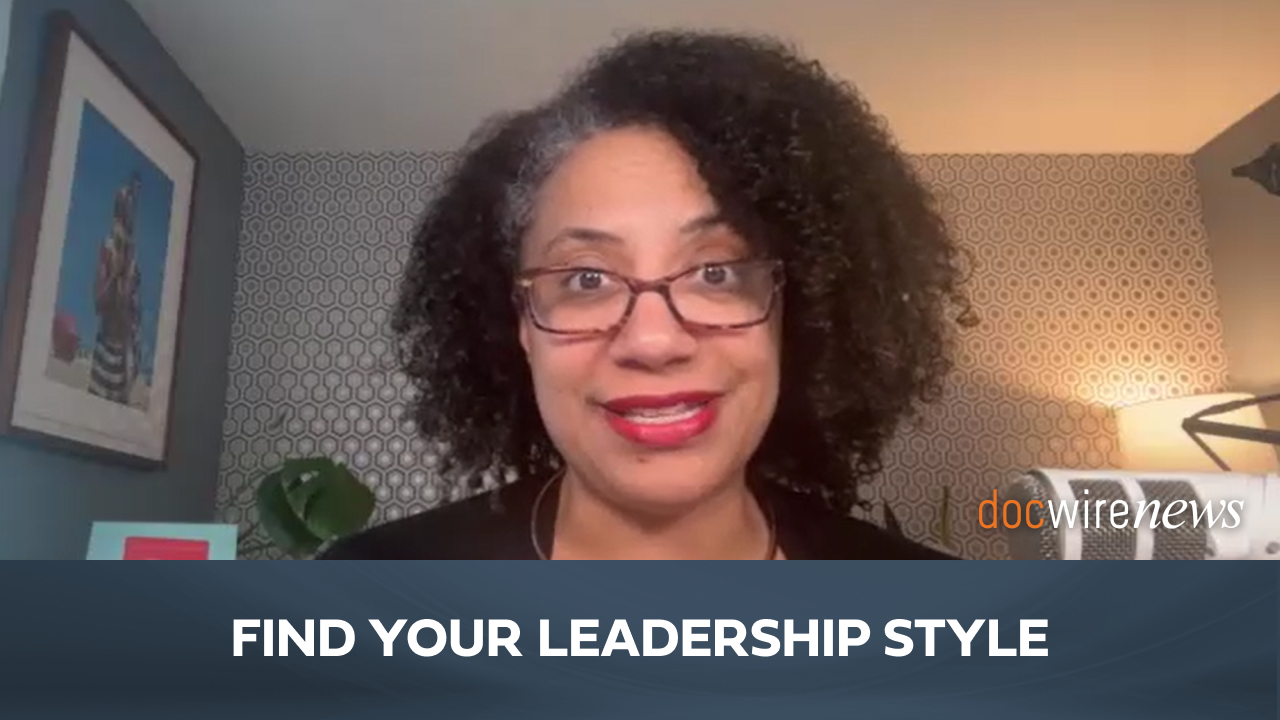
Monique Nugent, MD, MPH, a hospitalist at South Shore Health and author of Prescription for Admission, breaks down what “leadership style” really looks like in day-to-day clinical practice, from how clinicians communicate with their teams to how they respond to feedback, manage change, and set expectations. She explores the intersection of leadership and clinical skills, how clinicians can identify their strengths and blind spots as leaders, and why intentional skill-building, reflection, and mentorship are essential. Dr. Nugent also offers several practical resources for healthcare professionals looking to develop their leadership skills.
–
Transcript:
For healthcare professionals, what does it mean to have a “leadership style,” and why does it matter?
Dr. Nugent: Leadership style, the definition of it is the tool set and the way that you are presenting yourself to your team through guiding the team; motivating the team through tasks and changes; and then managing, that day-to-day touchpoint. You could Google or look in textbooks and find the technical lists of the different styles. There’s the authoritative style; there’s the democratic style. But when I think about leadership style for healthcare professionals, really what I want people to focus on is how are you presenting yourself to your team so that they know how they’re going to interact with you.
What are they going to get when they come and talk to you? Are you going to be open? Is your door always open, inviting conversation? Or is it a little bit more formal, that they have to make appointments to see you, knock on the door? Do they know that when they ask you for something, you’re going to be receptive to the things that they’re saying, you’re going to be supportive immediately? Or are you someone who’s going to take some time to take in the feedback and process before you get back to them? When they ask for something, what’s the speed in which those things are going to be carried out? Are you someone they can count on to get it done pretty quickly? Or is it that you’re going to take some time to reflect and feedback to them, “Hey, maybe we can do this, maybe we can do that,” before moving on with the task?
It’s really that feeling that people get when they come to you for leadership. That is what your leadership style is.
Yes, I want you to go back and read about the technical ones, the actual definitions of leadership styles—but when you think about how you’re moving with your team every day, it’s every moment-to-moment interaction with them: what they know they’re going to get from you, that feedback, that support. That is what your leadership style is. You may easily fall into one of those categories or you may find that you’re in between things—or you may find that tasks require different leadership styles from you. But your specific leadership style, your team is going to know because they’re going to know what they can get from you each and every time they interact with you.
How do leadership skills differ from the skills needed in clinical care? Where is there overlap?
Dr. Nugent: The great thing about medicine is that you get a lot of opportunities to learn your leadership style and practice leadership throughout different phases of your career. Early in your career as a medical student, you’re not in a leadership position, but you’re in a position to learn from leaders. Those leaders are on so many different levels: your professors, your attendings, the residents.
Then one day you’re the intern. Again, you’re not the top of the leadership ladder, but you are now practicing medicine. You are the leader of that interaction between you and the patient, you and the nurse, you and the physical therapist. You are the leader in those interactions.
You become the resident. Now you’re managing a team. This is the first time you’re really putting those leadership skills [to use] and, like I said, [showing] what your team can expect from you. Are you going to be a really easygoing, supportive resident who gets through the day kind of easily and doesn’t really micromanage? Or are you someone who really goes through the list multiple times a day and you’re checking boxes and you’re making sure everything is what you think it should be?
Then you become the attending. Even if you’re not teaching residents, you are put back in that leadership position of you and the patient, you and the nurse, you and the interdisciplinary team. If you’re teaching residents, now that’s a little bit more formal. How am I teaching? How am I going to lead these different levels of learners?
Medicine gives you this opportunity to try leadership at very different stages in your career, but above all, medicine teaches you that you are still a leader. You are always going to be the captain of the ship at some point because you’re the person who is holding that clinical information and making those clinical decisions. Things kind of fall to you, so learning how you interact with your patients, what patients feel that they can get from you every time they come to you—that is leadership right there.
It’s important that even if you’re looking at your career and you’re like, “Oh, I don’t think I want to be a CMO or a CEO,” I want you to still look at your career and realize that you are a leader. You are the leader of a care team at any point in time, and you should still learn leadership skills so that you can be effective in that role and your patients can get the most out of you.
How do you identify your personal strengths and weaknesses as a leader?
Dr. Nugent: The most important thing a leader can do is ask for feedback. I think we get to a position sometimes where we have an official title and we think, “Oh, maybe I’m not supposed to be asking for feedback,” or “I should only be asking for feedback from the people who are directly above me.” But the people who are working with you that you are charged with leading, you should be asking for their feedback as well.
One of those whole 360° feedbacks. Feedback from above, feedback from the same level, feedback from somebody who is working under your leadership—because in the end, that person, your team, are the end users. They’re the end experiencers of your leadership and what they experience is really going to determine where you go next. We all think, Oh, we just build our CVs, our resumes by ourselves, but that’s not the case. How you move up, how you go through your career is a direct reflection on what you’re doing right now. Asking for feedback from people who are under your leadership, asking for feedback from people who are your cohort. [Asking them questions like,] “How are you managing this thing? How do you think this went? How did that presentation go? What do you think I can improve on?” Asking for feedback from your direct leaders is also important.
Then I want people to also take some time to do some self-reflection. For me, some of the times that I think I have made some of the biggest changes in how I will interact with patients and my team has been when I’ve taken the time to sit down and say, “Whoa, what just happened and how did that go south or how did that go well? How am I going to take that information and that experience and move forward?” That self-reflection is extremely important as well. A good leader needs to be able to have some quiet time to think about how they’re going to do the next steps and what they feel they’re doing well and what they feel that they can improve on.
Also, find a mentor—and find a mentor who is in a space to give you really good and insightful feedback. I had someone once tell me, “There’s going to be people in your life who tell you you walk on water, do not believe them. There are going to be people in your life who tell you you can’t do anything right, do not believe them.” The truth is exactly somewhere in the middle. What you’re looking for is the person who can give you that critical, in the middle feedback, not someone who’s just going to be as sycophant and say, “Oh, that was great. That was wonderful. You’re going to be the best.” You’re looking for someone who can give you really good conversation and feedback and help you with that self-reflection to grow.
There are also actual tools out there. You can pick up some books. There’s the StrengthFinder book. There are courses you can take. I’m sure if you go on any business school’s website [and] they probably have community resources or webinars or online classes and tools you can sign up for where you can go through and do some more formal assessment of your leadership style. Those are really great, too, so I want people to use all of these tools in their toolbox.
What other resources are available to help hone your leadership style?
Dr. Nugent: Seven Habits of Highly Effective People is a classic book and until you read it, or until you listen to it, and until you actually put it into practice, I don’t think you get the value of the book and these seven habits. When you do finally pick up this book—which I highly encourage people to do—take [it] and do a PDSA of these habits: plan, do, study, act. That’s a really effective tool, not just for leadership skills, but for basically anything that you want to put into practice in your life. I do it for my week-to-week to see how I can get through the week with managing the kids and my life and things like that, but his is a really effective tool for managing change and managing a team. I really encourage people to try these seven habits for highly effective people and PDSA these habits in your own life.
The next book that I talk about is, again, a real classic, and it has a cheesy title that people may have heard all the time. It’s How to Win Friends and Influence People. People think, “Oh, I’m kind of charming. That’s fine.” No, that’s not what this is about. It’s really about how are you speaking to people that encourages people to want to continue to speak to you—which means how are you building relationships? At the core of leadership is relationship-building and relationship maintenance. It’s, again, a classic book, a really easy one to put onto your Audible and listen [to] while you’re driving, but it really does show you that these are skills you can learn and skills you can continue to hone.
The third book is Good to Great, and that’s another classic about how are we getting from place to place in our leadership, in our work. It’s a great tool for people who are saying, “Well, I think I’m really good at this already.” You would be surprised at how much you can change and how much you can improve.
I also encourage people to get actual formal training on leadership. You went through and you got formal training to be a physician and in that formal training, you got feedback, you got tools, you got textbooks, you got examples, and you got tests. You came out on the other side with a skill. Leadership is a skill. I think we just assume that when people are bright enough and charismatic enough, they’ll be good leaders, and that is just not the case. It’s something you really have to learn.
[Getting] formal training from a business school, a professional society—not only does that give you actual coursework and things you can go through, tools you can put into practice, but a lot of the times it comes with community. People who are also looking to build this skill set, people who are also already in the process of moving through their leadership journey. That community will be extremely valuable, not just for building these skills and getting mentors and reflecting, but it’s also going to be a great community for you professionally. Something to tap back into as you move through your career to see what different opportunities are available to you in leadership and the different ways that leadership in medicine manifests.
link